Cart
0
You might also like



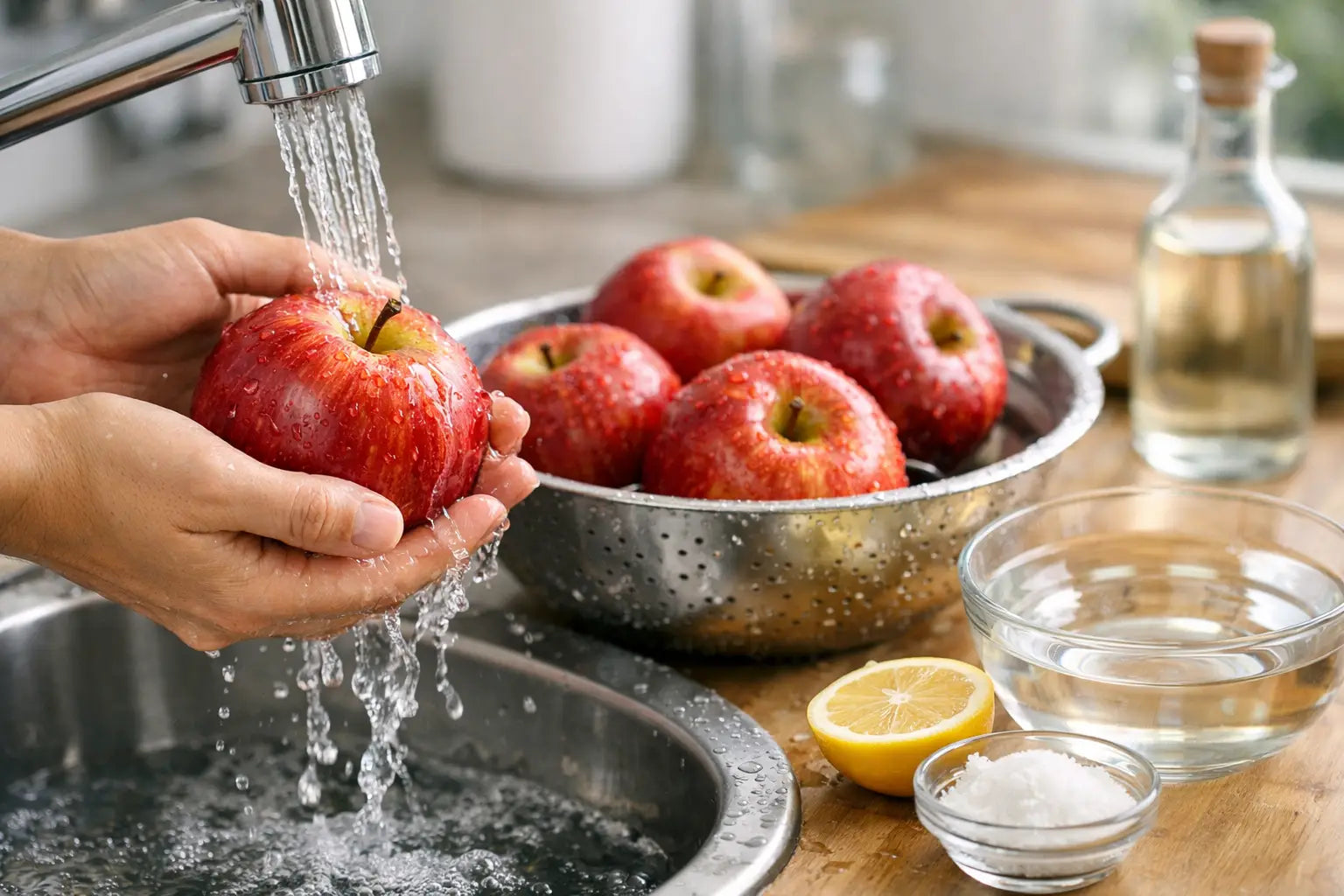
A shiny apple looks healthy. Yet, its appearance says nothing about what remains on its surface after harvesting, transportation, and display in stores. If you are looking for simple and reliable ways to remove pesticides from apples, the real issue is not just rinsing longer. It's primarily about choosing a method that genuinely helps reduce residues, without complicating meal preparation.
Apples are among the fruits many families buy every week. They are convenient, keep well, and end up in lunch boxes as often as on the breakfast table. But they also have thin skin, often eaten as is, which explains why so many consumers want to clean them better before eating.
The problem is that water alone has its limits. A simple rinse under the tap can remove some dust, visible dirt, and certain surface residues. However, when it comes to pesticides, wax, impurities stuck to the skin, or contamination related to handling, conventional rinsing does not always provide the desired level of peace of mind.
This is where many households find themselves in a gray area. They want to do better, but without turning every grocery run into a chore. For most people, the right solution is one that genuinely improves food hygiene, while remaining quick and easy to repeat daily.
There are several ways to clean apples at home, but not all are equal. Some methods are useful for basic cleaning. Others go further and better meet a simple expectation: to further reduce what remains on the fruit before serving.
This is the most common reflex, and it's not useless. Rubbing the apple under cold water for several seconds helps remove some surface residues, especially visible impurities. It's better than doing nothing.
But we must be honest about its limitations. Water is not designed to effectively treat all chemical residues, nor to act deeply on what adheres more to the skin. If your goal is only to remove apparent dirt, this may suffice. If you are looking for more reassuring protection for your family, this is generally not the most comprehensive method.
These homemade solutions are often cited. Soaking apples in water with a little vinegar or baking soda can help dislodge certain deposits and improve cleaning compared to a simple rinse. Many consumers adopt them because they are accessible and inexpensive.
That said, there are trade-offs. You have to prepare the solution, measure, wait for the soaking time, then rinse again. The taste or smell can also be bothersome if rinsing is incomplete. Most importantly, these methods remain variable. They depend on the right mixture, the time left in the water, and the care taken in rubbing. For daily use, they often end up being abandoned because they require more effort than expected.
Yes, removing the skin can reduce some of what is on the surface. But it also removes some of the fiber and nutrients present in the skin, without solving the cleaning issue before handling. So, it's not always the ideal answer, especially if you like to eat whole apples or if you prepare fruit for children.
In practice, peeling is more of a compromise than a real washing solution. It may be suitable in some cases, but it does not replace serious cleaning.
For many households, the real criterion is not just theoretical effectiveness. It's ease of use. A method that is too long or too complicated rarely lasts in the long run. However, food safety at home often depends on regularity.
A device designed to clean fruits and vegetables with a process adapted for domestic use better meets this reality. Instead of relying on approximate rinsing or repetitive homemade recipes, you adopt a simple, quick, and more consistent routine. This is particularly useful if you often buy apples, grapes, strawberries, or vegetables eaten with their skin.
The main advantage is peace of mind. You no longer wonder if you've scrubbed hard enough, if the soak lasted long enough, or if water alone did the job. You have a solution designed to better eliminate residues, impurities, and some contaminants that the eye cannot see.
Not all promises are equal. When you choose how to clean your apples, a few criteria really make a difference.
First, there's simplicity. If a method takes too long, it will be reserved for good intentions. Then, there's consistency. A good solution should yield reproducible results, not depend on approximate actions. Finally, there's versatility. If you can use it for apples as well as for other fruits, vegetables, or certain everyday foods, it naturally becomes a useful habit.
This explains the growing interest in food cleaning devices designed for regular home use. They meet a very current expectation: better protecting what we serve, without burdening meal organization.
The first mistake is confusing a clean appearance with a truly cleaned fruit. An apple can look neat and yet retain residues on its surface. The second is believing that a very quick rinse is always enough. This is rarely the case when you want to go beyond simple dust.
Another common mistake is washing all apples upon purchase and then storing them wet. This can reduce their shelf life if they are not properly dried. In most cases, it's better to clean them at the right time, before consumption or before preparation.
Finally, many people abandon any effective routine because they tried an impractical homemade method. It's not the need that disappears. It's simply the method that doesn't hold up in real life.
Yes, absolutely. Organic does not mean without dirt, without natural wax, without handling, or without exposure to the environment. Even when choosing products perceived as more reassuring, cleaning is still necessary before eating or cooking.
The issue is therefore not just the type of farming. It also concerns transport, storage, handling by several people, and the general hygiene of the product. In other words, washing an organic apple remains a good habit, just like for others.
If you prepare snacks, lunches, or desserts several times a week, you need a realistic solution. The right routine is not the one that seems most serious on paper. It's the one you'll follow effortlessly, even on a busy weekday evening.
A simple approach is to clean apples with a dedicated method, then dry them properly before serving or storing them for imminent consumption. This reduces hesitation and provides a clear action to repeat. You save time, and most importantly, you reduce uncertainty.
It is in this spirit that solutions like the KSD Cleaner find their place in a modern kitchen. The goal is not to complicate food washing. It's the opposite. To make the right reflex simpler, quicker, and more reassuring.
Ultimately, most people are not looking for a perfect laboratory method. They want a concrete answer to a very simple question: am I doing enough to better protect my family?
When it comes to apples, the answer depends on your level of expectation. If a quick rinse is enough for you, water will do part of the job. If you want to go further to further reduce residues and improve the hygiene of what you serve, you need a more serious and consistent solution.
This is often where the decision becomes clear. Not between natural and technological, nor between simple and complicated, but between uncertainty and trust. When your cleaning routine brings you true peace of mind, eating healthier also becomes easier.
Next time you place apples on the counter, think less about their shine and more about what your cleaning method actually allows you to remove. It is often this small, invisible gesture that most changes the way you serve food with confidence.

