Cart
0
You might also like


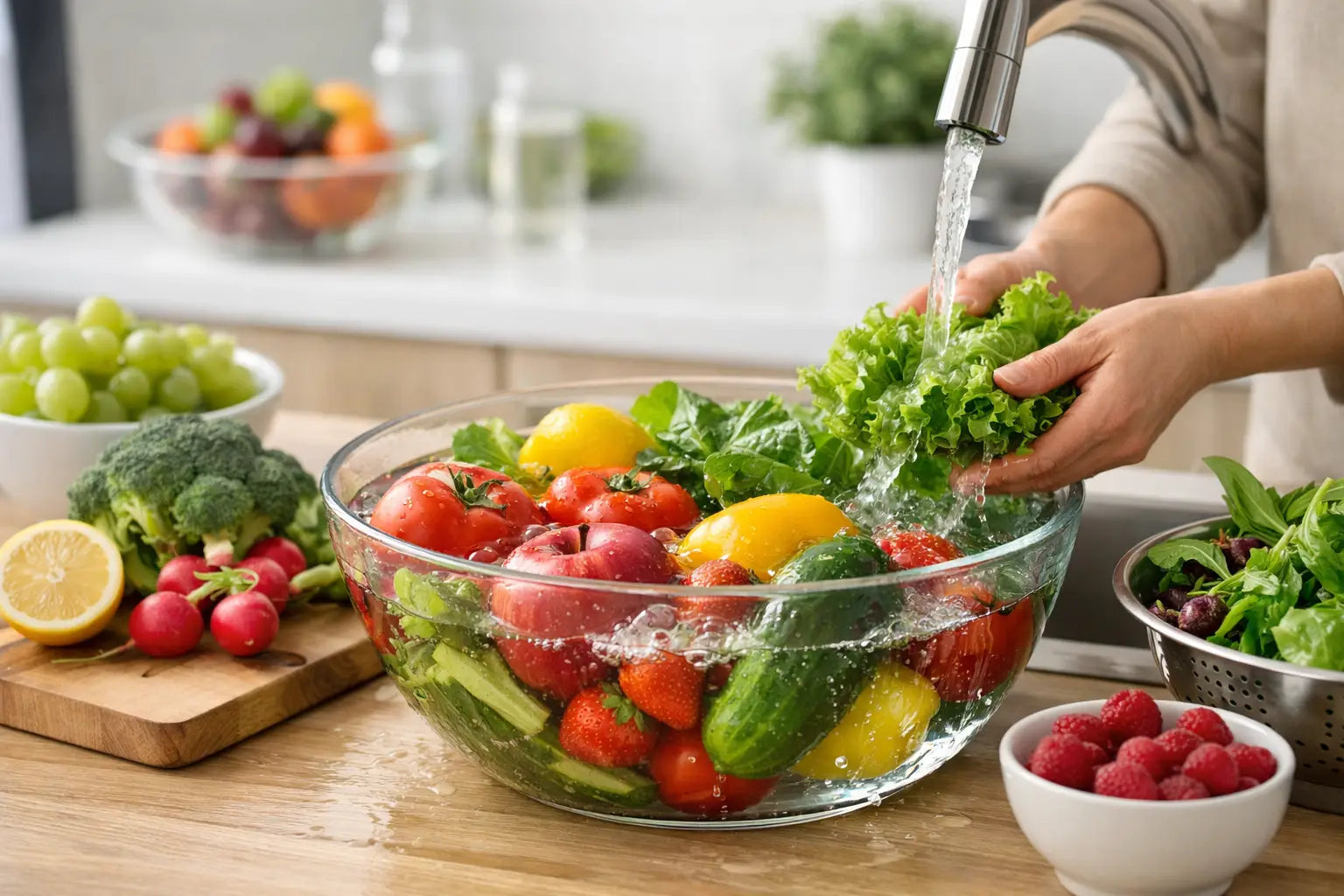
You rinse your fruits and vegetables in a few seconds under water, then you sit down to eat. It's quick, but it's not always enough when you consider pesticide residues, bacteria, dirt, or the handling they undergo before reaching your kitchen. If you're looking for how to sanitize produce safely, the right approach isn't to wash harder. It's to wash smarter.
The reality is that fresh produce can look clean and yet still harbor invisible impurities. Between cultivation, harvesting, transport, storage, and shelf stocking, food passes through many hands and surfaces. For a family that wants to better protect its health daily, the question isn't just about making food look better. It's about reducing what you can't see.
The first point to understand is simple: cleaning and sanitizing don't always mean the same thing. Rinsing with water helps remove some surface dirt. However, this can be limited against certain chemical residues, bacteria, and impurities that adhere more strongly to the food's skin.
This is why many households seek a more reliable solution than simple rinsing. But in this search, we also see bad habits circulating: dish soap, diluted bleach, vinegar used as a miracle solution, baking soda for everything. The problem is that a popular method is not necessarily a safe one.
If your goal is to better protect your household, the right approach relies on two criteria: real effectiveness and food safety. Cleaning that leaves undesirable residues on your food is not a good solution, even if it gives an impression of cleanliness.
Soap is one of the most common mistakes. Many people think that if it works for hands or dishes, it must also be suitable for fruits and vegetables. However, food is porous, especially thin-skinned produce like strawberries, grapes, tomatoes, or apples. They can absorb soap residues, which have no place on a plate.
Bleach poses an even more obvious problem. Even highly diluted, it is not meant for direct use on food intended for consumption. It's an aggressive method that can create more risks than it eliminates.
Vinegar, on the other hand, has a reassuring reputation because it seems natural. It can help in some cases to remove some surface dirt, but it should not be considered a complete solution. Its effectiveness varies depending on the food and what you're trying to remove. For daily use focused on reducing residues, bacteria, and impurities, it remains a partial solution.
Baking soda can also be useful for some products, but it requires time, correct dosages, and careful rinsing. For many households, this quickly becomes a demanding routine. And when a method is complicated, you often end up not using it regularly.
For most households, the best method is one that combines simplicity, safety, and visible results. This starts with a quick sort. Remove damaged leaves, very dirty parts, or outer packaging. Then, proceed to cleaning with a solution designed for food use, rather than household products repurposed from their function.
This is where an electrolytic fruit and vegetable cleaner makes perfect sense. This type of device has been designed to help reduce pesticide residues, bacteria, and impurities without adding friction to your routine. Instead of improvising with homemade recipes, you use a more direct, more regular, and better-suited method for what you serve your family.
The benefit is not only technical. It's also practical. When cleaning takes only a few minutes and requires little effort, you are more likely to do it systematically. And when it comes to food hygiene, regularity changes everything.
Not all fresh produce is cleaned the same way. Root vegetables like potatoes, carrots, or beets retain more soil. They often require an initial rinse to remove visible dirt before a more thorough cleaning.
Thin-skinned fruits like strawberries, cherries, or grapes are more delicate. Avoid rough handling that can damage them and accelerate their deterioration. It is precisely for these foods that aggressive methods are least suitable.
Leafy vegetables, such as lettuce, spinach, or kale, deserve special attention. Impurities can lodge between the leaves, and a quick rinse under water is not always enough. It is often better to separate the outer leaves and allow for more uniform cleaning.
Thick-skinned fruits, such as citrus, avocados, or melons, are sometimes neglected on the grounds that their skin is not eaten. However, the knife can transfer contaminants from the surface to the flesh when cutting. Cleaning them is therefore still useful.
In other words, the right method depends on the product, but the principle remains the same: remove what is visible, then treat what is not.
Cold tap water still has a real use. It helps remove dust, some dirt, and certain surface contaminants. That's already better than nothing, and it's a good first step.
But we have to be honest about its limitations. Water alone was not designed to effectively target all residues present on food. When you want to go beyond a visual rinse, you need a more suitable solution. This is particularly true if you often buy conventional produce, if you have young children at home, or if you are simply looking for more peace of mind.
The point is not to create fear. It is to recognize that a basic action does not always provide the desired level of protection.
The best routine is one you can stick to every week without excessive effort. After shopping, start by separating fragile foods from those that can withstand more robust handling. Clean what you will consume quickly, then prepare the rest according to your storage habits.
If you use a dedicated food cleaning solution, follow the recommended time and avoid mixing several methods thinking you'll do better. Too much handling can be unnecessary, even counterproductive. The goal is to obtain a safe result, not to turn this step into a chore.
It is also useful to clean surfaces, strainers, containers, and cutting boards that come into contact with produce before and after washing. Well-cleaned food can be recontaminated in a few seconds on a dirty surface. Here again, it is often simple details that make the difference.
Consumers are more attentive than before to what they serve at home, and that's logical. Eating better is not just about buying more fruits and vegetables. It's also about preparing them better.
A dedicated solution provides reassurance because it reduces improvisation. You don't have to wonder if the vinegar dosage is correct, if the baking soda should soak longer, or if you're unintentionally leaving soap residues. You adopt a clearer, faster, and more consistent routine with a simple goal: protecting your health with less uncertainty.
For active families, this is often what makes the difference between a good intention and a lasting habit. A device like KSD Cleaner fits naturally into this logic: less doubt, fewer constraints, more confidence when cooking.
You don't need to turn every meal into a laboratory protocol to better protect your household. What matters is having a safe, simple, and practical enough method to actually be used, not just for a week. When cleaning fresh produce becomes a reliable reflex, healthy eating also provides what many ultimately seek: a little more serenity with every meal.

