Cart
0
You might also like


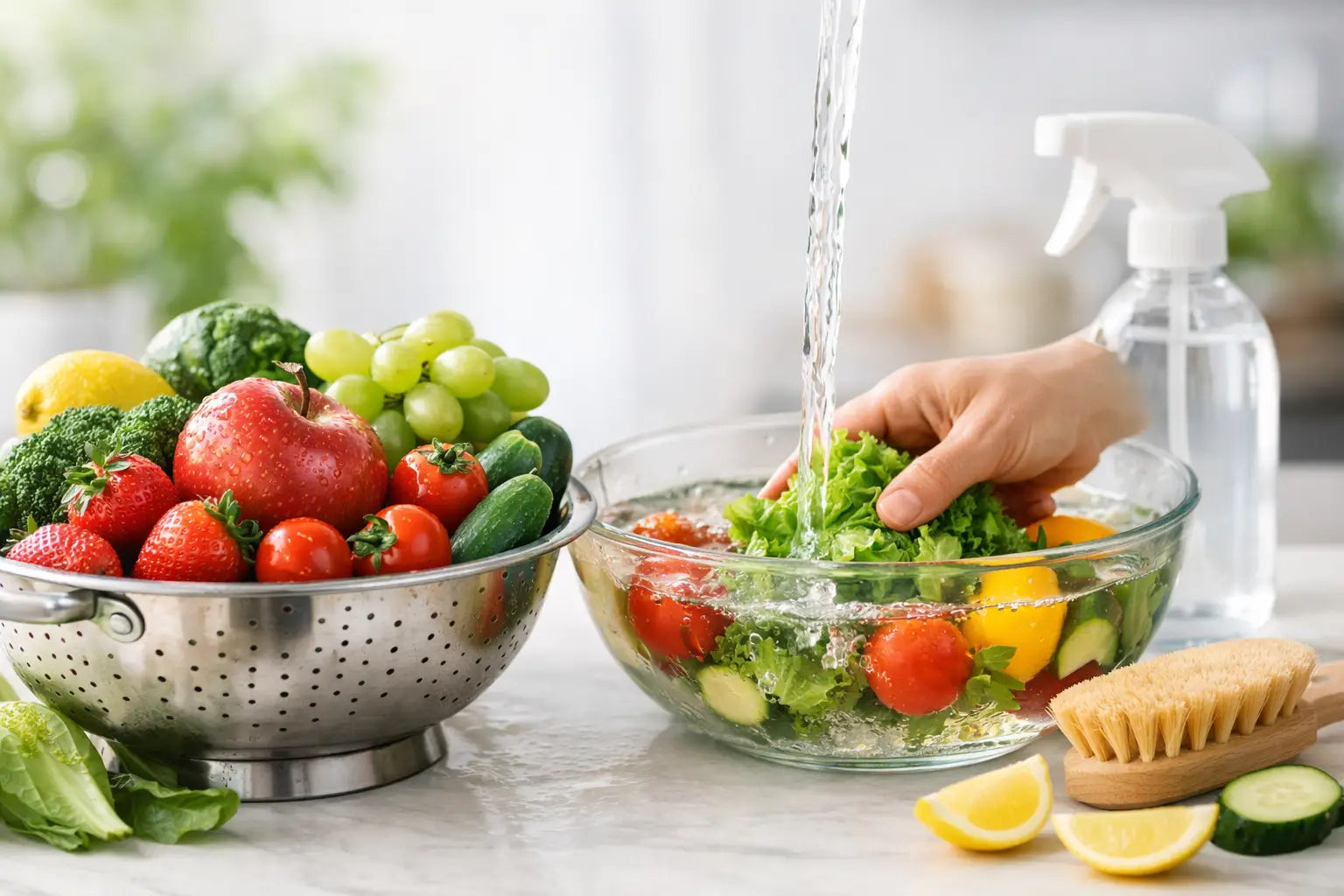
You've rinsed your strawberries, scrubbed your apples, soaked your lettuce... and yet doubt remains. If you're asking yourself what is the best fruit and vegetable cleaner, the real question is simpler: what solution truly removes residues, impurities, and some contaminants without complicating your routine?
For many households, washing fruits and vegetables with plain water seems sufficient until they think about surface pesticides, handling in stores, transportation, bacteria, and invisible dirt. The best cleaner isn't just one that cleans "a little." It's one that provides a more convincing level of cleanliness, without taking time or adding unnecessary products to your kitchen.
There isn't one universal answer when comparing all habits, budgets, and levels of expectation. However, there is a clear answer for households that want more than a simple rinse: an electrolysis cleaner is currently one of the most comprehensive options for removing residues, bacteria, and impurities simply and quickly.
Tap water alone removes some visible dirt. It's better than nothing, but it remains limited. Vinegar is often cited as a homemade solution, but its effectiveness largely depends on soaking time, food type, and the type of residues present. Commercial sprays or washing solutions can be reassuring, but they add a recurring purchase and sometimes raise another question: should what you've just applied to your food then be thoroughly rinsed off?
Electrolysis cleaning devices address this problem in a more modern way. They don't rely on a fresh scent or a feeling of cleanliness. They aim for a concrete result: helping to loosen and reduce what shouldn't end up on your plate.
Rinsing with water remains the basic reflex, and it has its place. It helps remove dust, some debris, and certain surface residues. For vegetables that have been handled very little or products that are peeled afterward, this may seem acceptable.
But in real life, food passes through many hands. It is harvested, transported, stored, displayed, picked up, packaged, and then stored in your refrigerator. Between this journey and the potential use of agricultural treatments, many consumers are no longer satisfied with a quick ten-second rinse.
The important point is the level of expectation. If you're just looking to remove visible dirt from a potato, water does the job. If you're looking for more peace of mind for fruits your children eat raw or for salad leaves that are difficult to clean thoroughly, water quickly shows its limits.
Homemade solutions are popular because they seem natural and economical. White vinegar, for example, is often recommended for soaking vegetables. Baking soda also regularly appears in advice shared among consumers.
The problem is that these methods are variable. They require the right proportions, the right soaking time, and a serious rinse afterward. They can leave an odor, slightly alter some fragile foods, or become an extra step in an already busy routine.
Commercial liquid cleaners sometimes promise more, but they don't always simplify things. You add a product, measure it, apply it, rinse it. It's not necessarily complicated, but it's not the most fluid solution for daily use.
For an active family, the best choice is often the one that is actually used every day. A theoretically effective method that is difficult to repeat often ends up abandoned after a few weeks.
In terms of performance, simplicity, and regularity, an electrolysis cleaning device stands out significantly. This type of solution is designed to clean fruits, vegetables, and, depending on the model, other foods such as certain meats, in just a few minutes.
Its main advantage is this: it easily integrates into the routine. You place the food in water, start the cycle, then rinse if necessary depending on use. No mixing to prepare, no product to repurchase constantly, no homemade recipe to improvise based on what's left in the cupboard.
This is particularly interesting for people who often buy fresh produce, prepare meals at home, and want a more convincing solution than simple manual washing. The benefit is not only hygienic. It is also mental. You gain confidence when serving.
The best fruit and vegetable cleaner is not judged solely on a marketing promise. It must meet four very concrete expectations.
First, it must be simple. If use requires too many steps, the appliance or method will end up in the back of a cupboard. Second, it must be fast. Few people want to add twenty minutes to dinner preparation. It must also inspire confidence, with clear operation and easy-to-understand usefulness. Finally, it must adapt to real daily life: weekly shopping, hurried meals, children's snacks, salads, berries, apples, grapes, fresh herbs.
A good cleaner does not replace common sense about food. It does not turn spoiled produce into healthy food. However, it can provide useful additional protection against residues and impurities that classic rinsing does not always remove sufficiently.
This solution is particularly meaningful for households that consume a lot of raw produce, for parents, for health-conscious individuals, and for those who want to limit their daily exposure to certain residues without complicating every meal.
It is also very suitable for consumers who prefer to invest in a durable solution rather than multiplying purchases of sprays or cleaning liquids. The initial cost may be higher than a bottle of vinegar, of course. But the comparison is not entirely fair. We are not talking about the same level of user comfort or the same objective.
One must also be honest about expectations. If you are looking for the cheapest method possible, water and some homemade solutions will remain ahead. If you are looking for the best combination of perceived effectiveness, practicality, and peace of mind, electrolysis clearly takes the lead.
Before buying, ask yourself a simple question: do I just want to wash, or do I want to better protect what I serve my family? This nuance changes everything.
If your absolute priority is minimal price, a homemade method may suffice temporarily. If your priority is to save time while going beyond classic rinsing, a dedicated appliance is more consistent. Then look at ease of use, cycle duration, capacity, clarity of promises, and the trust you have in the brand.
A product like the KSD Cleaner fits precisely into this logic. It does not seek to transform the kitchen into a laboratory. It offers a simple answer to a very concrete concern: better cleaning what we eat every day.
Many health decisions fail not because they are bad, but because they are too restrictive. This is true for food, for physical activity, and also for food hygiene. A good solution is a solution that is maintained over time.
That's why the best answer to the question what is the best fruit and vegetable cleaner is not just technical. It is practical. The best cleaner is the one that truly helps you remove more impurities and residues, without slowing down your daily life.
For occasional use, water may suffice. For a higher demand, homemade solutions quickly show their limits. For a simple, quick, and more reassuring routine, an electrolysis cleaner is currently the most convincing choice.
Ultimately, cleaning your fruits and vegetables should not be a chore or a gamble. It should be a simple gesture that leaves you with only one feeling when it's time to eat: you've done what's necessary to better protect what you're serving.

