Cart
0
You might also like


Do you think rinsing your fruits and vegetables under running water is enough to clean them? Most people do. And yet, studies show that this habit removes only a portion of the pesticide residues on the surface — letting the most stubborn contaminants slip through.
In this article, we explain why water alone is not enough, which fruits and vegetables are the most contaminated, and which method effectively removes residues to protect your family.
Pesticides don't simply sit on the surface of food. Some are fat-soluble (dissolve in fats), others penetrate the natural or artificial wax coating on fruits. Cold water, no matter how much you use, cannot dissolve these substances.
According to data from the Environmental Working Group (EWG), the most pesticide-contaminated non-organic fruits include:
And on the vegetable side, celery, bell peppers, and leafy greens are no better.
Running water can remove:
Running water cannot remove:
Popular and affordable, vinegar helps loosen some residues. But it requires a 15 to 20-minute soak, slightly alters the taste of food, and remains ineffective against fat-soluble pesticides.
A study from the University of Massachusetts showed that soaking for 15 minutes in a baking soda solution removed surface pesticides better than water alone. But again, embedded residues resist.
Effective for hard-skinned vegetables (carrots, potatoes), useless for thin-skinned fruits or leafy greens.
This is where a more advanced technology comes in: water electrolysis.
The principle is simple: by passing an electric current through water, the device generates hypochlorous acid (HOCl) — a molecule naturally produced by our own immune system to fight pathogens.
Hypochlorous acid has remarkable properties:
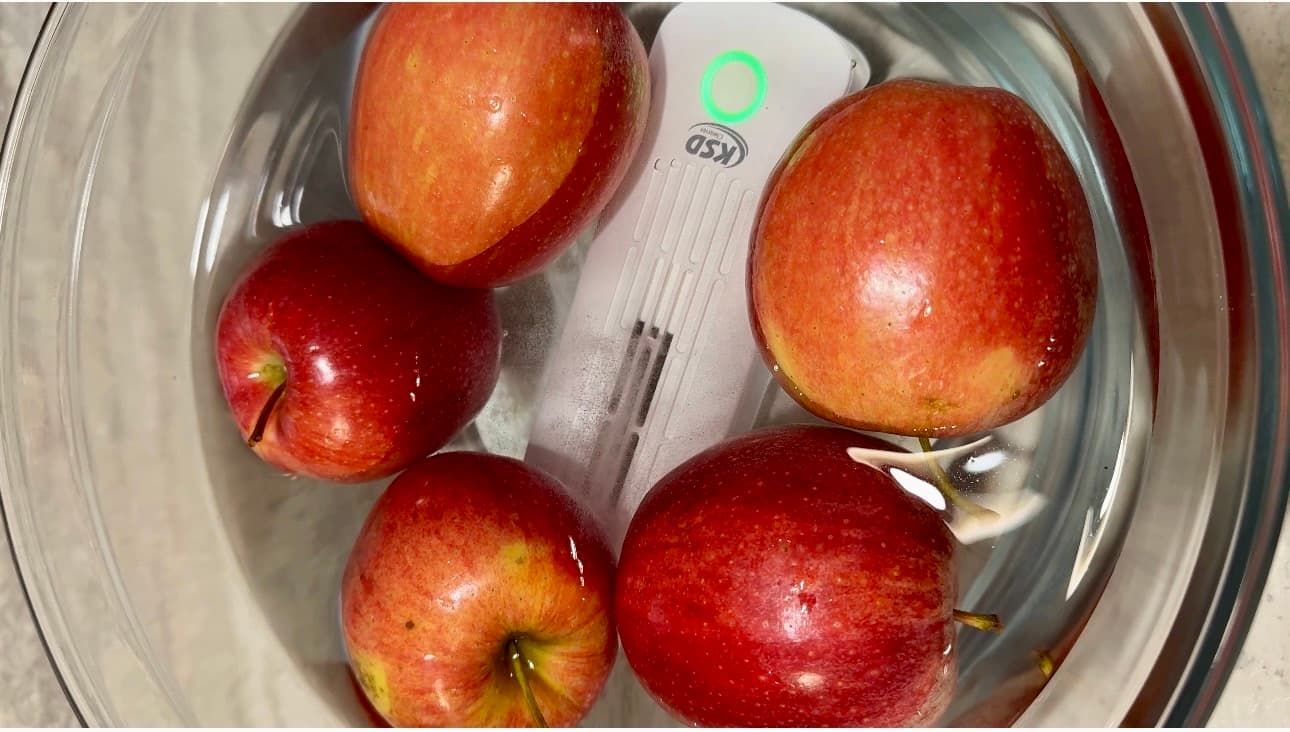
The KSD Cleaner (model GFC11) is a mini wireless fruit and vegetable cleaner that uses precisely this water electrolysis technology.
Mild Mode (5 minutes) Ideal for a quick daily clean. A single click on the button starts the electrolysis. Perfect for thin-skinned fruits and vegetables, fresh herbs, or lightly contaminated foods.
Deep Mode (10 minutes) For a thorough cleaning of more exposed foods — meats, non-organic fruits, field-grown vegetables. The electrolysis works longer for optimal results.
| Method | Surface Pesticides | Embedded Pesticides | Bacteria | Duration |
|---|---|---|---|---|
| Cold water | Partial | ❌ | Partial | Immediate |
| Vinegar | Moderate | Low | Moderate | 15-20 min |
| Baking soda | Good | Low | Moderate | 15 min |
| KSD Cleaner | ✅ Excellent | ✅ Very good | ✅ Excellent | 5-10 min |
The KSD Cleaner is especially recommended for:
Rinsing your fruits and vegetables with water is a good start. But faced with modern pesticides, post-harvest treatments, and resistant bacteria, water alone is no longer enough.
Water electrolysis is today the most effective and natural method to deep-clean your food — without chemicals, without effort, and in just a few minutes.
The KSD Cleaner GFC11 puts this technology in your hands, in a simple, compact, and wireless form.
→ Discover the KSD Cleaner and order yours directly from our store.

